

Technician Quick Answer
On electric ovens and ranges (GE, Frigidaire, Whirlpool, KitchenAid, Samsung, LG, Bosch), F3 (or F4 / F30 / F31) points to an open or shorted 1,080-ohm RTD oven temperature sensor probe, F1 (or F10) indicates a control board relay or touchpad runaway fault, and F9 indicates a motorized self-clean door latch switch fault. On induction cooktops, U (or u) means non-magnetic cookware, while E0 / E2 / F points to the internal cooling fan or IGBT power inverter board.
1. Testing F3 / F30 Oven Sensor Codes vs. Control Board Relays
When an electric oven beeps and flashes F3, F4, or F30, the control board has lost a believable resistance reading from the pencil-sized stainless-steel RTD (Resistance Temperature Detector) probe bolted inside the upper back wall of the oven cavity.
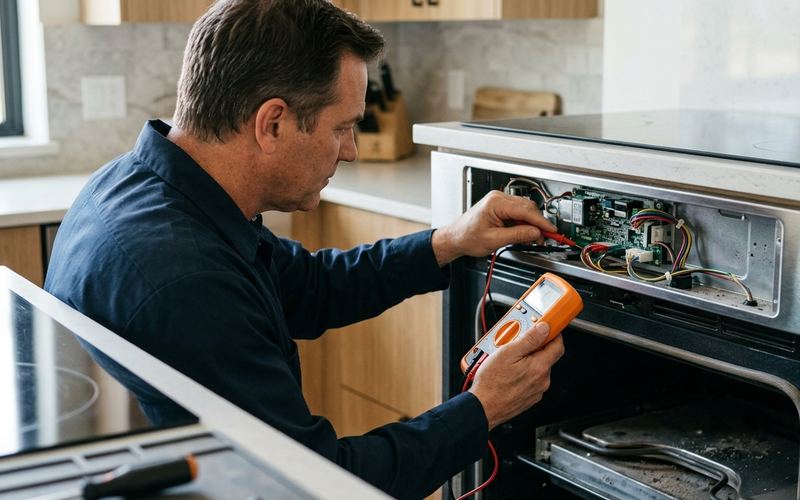
At 70°F (21°C) room temperature, a healthy platinum RTD oven sensor measures almost exactly 1,080 to 1,090 ohms across its two harness pins. Before ordering an expensive control board, our technicians unplug the sensor harness, measure the probe directly with a digital multimeter, and inspect the rear plug connector—which frequently oxidizes from oven steam vented during baking.
| Range / Cooktop Code | Appliance Subsystem | Electrical Meaning & Technician Fix |
|---|---|---|
| F3 / F4 / F30 / F31 | Oven RTD Temperature Probe | The stainless temperature probe in the upper-rear oven corner is reading open (>2,500 Ω) or shorted instead of ~1,080 Ω at room temperature. |
| F1 / F10 / E1 | Electronic Oven Control (EOC) | Stuck membrane keypad ribbon or welded 240V bake/broil relay on the main oven control board. |
| F9 / F90 / dE | Self-Clean Door Latch Motor | Motorized lock cam or microswitch jammed after a high-heat self-cleaning cycle. |
| U / u (Blinking) | Induction Pan Detection | Cookware bottom is non-ferrous (aluminum/copper/glass) or smaller than the minimum coil diameter. Test with a cast-iron skillet. |
| E0 / E2 / F47 | Induction IGBT Inverter Module | Low/unbalanced 240V supply leg, clogged under-counter cooling fan, or shorted IGBT power transistor on the induction generator board. |
2. Why Self-Clean Cycles Trigger F9 Latch Locks & Blown Thermal Fuses
During a 900°F (480°C) pyrolytic self-clean cycle on a GE, Whirlpool, KitchenAid, or Frigidaire electric wall oven, heat builds up inside the poorly ventilated cabinet cavity. That extreme heat often trips the rear high-limit thermal safety fuse (leaving the oven completely dead or cold) or warps the motorized latch rod, triggering F9 with the oven door locked shut.
Our technicians safely release locked oven doors without bending the porcelain trim, replace blown thermal cutoffs, and verify cooling-fan airflow.
Need a Technician in Greater Victoria?
On-site diagnostics ($110–$160 CAD), preventative deep cleaning ($130–$180 CAD), and upfront flat-rate repair quotes before work begins.
3. Induction Cooktop E-Codes & IGBT Power Board Diagnostics
Induction ranges and cooktops generate high-frequency magnetic fields using insulated-gate bipolar transistors (IGBTs) mounted on aluminum heat sinks underneath the ceramic glass. If pet hair or grease blocks the intake vents underneath the cooktop, or if a power surge hits one leg of the 240V circuit, the driver board flashes E0, E2, or F47. We perform component- and module-level electric and induction range repairs across Greater Victoria.
Frequently Asked Questions
What does F3 or F30 mean on an electric oven?
F3 or F30 means the oven control board detected an open or shorted circuit in the RTD oven temperature sensor probe mounted inside the oven cavity, or in the wire harness connecting the probe to the control board.
Do you repair gas stoves or only electric and induction ranges?
West Coast Wrench services 100% electric cooking appliances exclusively—including induction cooktops, smooth-top ceramic radiant ranges, coil stoves, and built-in electric wall ovens. We do not service gas appliances.
Why is one side of my induction cooktop flashing an error while the other side works?
Most 30-inch and 36-inch induction cooktops use two separate IGBT generator modules—one for the left two zones and one for the right two zones. If one side flashes E0 or refuses to power on, that side's generator board or cooling fan requires service.