
The Science: How Induction Senses Cookware
Traditional electric radiant cooktops heat up an electric ribbon coil under glass whether a pan is present or not. Induction cooktops operate on an entirely different principle: **electromagnetic resonance**.
Beneath the ceramic glass sits a tightly wound flat copper Litz-wire coil. High-frequency AC current (20,000 to 50,000 Hz) generated by an internal inverter pulses through the coil, creating an oscillating magnetic field. When a ferrous metal pan is placed above it, the magnetic field induces swirling eddy currents inside the pan base, generating instant heat directly inside the cookware.
Every few seconds, the cooktop fires a micro-pulse "sensing" frequency. If it does not detect adequate magnetic resistance, it shuts off power and flashes an error to protect the high-power transistors.
1. The Refrigerator Magnet Test (Ferrous Content)
Just because cookware packaging says "induction compatible" does not guarantee your cooktop's electronic sensors will accept it. Many budget non-stick pans use an aluminum body with a thin, perforated steel "stamp plate" pressed into the bottom.
Take a strong fridge magnet and touch it to the bottom of the pan:
- Strong, instant snap: Cast iron, enameled iron, or magnetic stainless steel (400-series). Fully compatible.
- Weak, sliding grab: Thin composite bases or 300-series austenitic stainless steel. The magnetic flux is too weak, causing the sensor relay to click repeatedly and time out.
- Zero grab: Pure aluminum, copper, or glass. Zero heat will ever be generated.
2. Pan Diameter & Base Warpage
Induction coils have minimum pan footprint requirements. If you place a 4-inch butter warmer onto an 8-inch cooking ring, the magnetic coupling area covers less than 50% of the coil perimeter, triggering an immediate "no pan detected" flash.
Furthermore, if a pan was once overheated or quenched under cold water while hot, the base bows into a convex dome. If the center of the pan hovers 2 to 3 millimetres above the glass, the gap disrupts high-frequency flux lines.
3. When Two Burners Fail Simultaneously: IGBT Inverter Board
What if verified cast iron pans that worked yesterday suddenly trigger error codes on the entire left or right side of the cooktop? Induction ranges share power generation boards across pairs of burners.
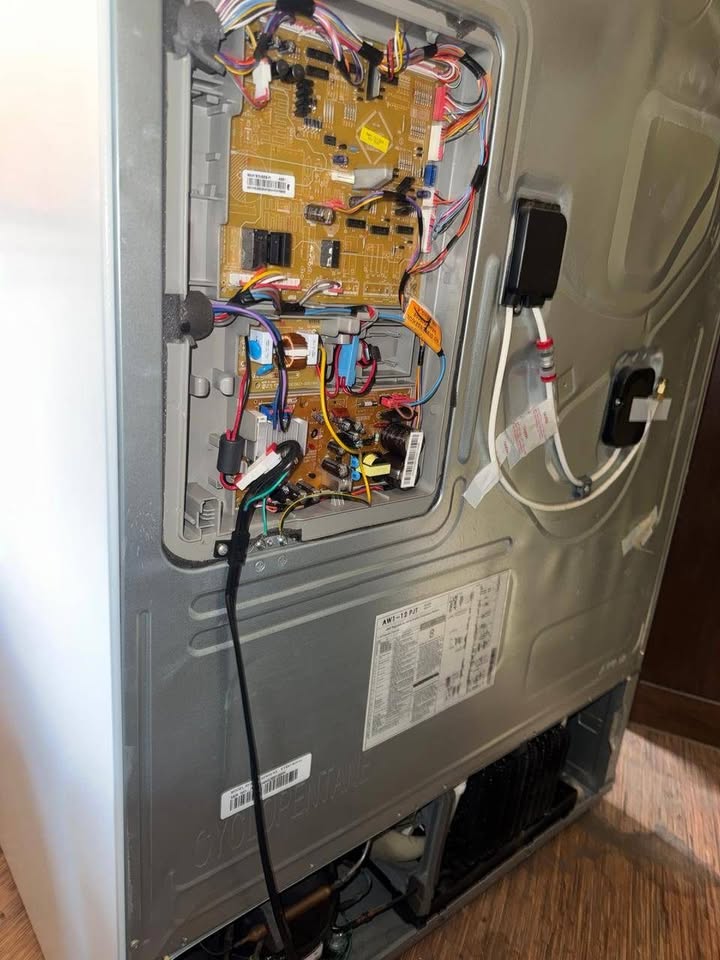
Each board houses heavy-duty **IGBT (Insulated-Gate Bipolar Transistor)** switches, bridge rectifiers, and high-frequency filter capacitors cooled by a dedicated fan. A high-voltage spike or blocked cooling intake vent can short an IGBT channel, putting that half of the appliance into protection mode. Resetting the main double-pole breaker for 5 minutes clears soft lockouts; persistent errors require board diagnostics.
4. Surface Glass Thermal Sensor Disconnect
Under the glass at the center of each coil rests a spring-loaded NTC temperature sensor that monitors pan temperature to prevent dry-boil fires. If the sensor lead disconnects or thermal paste dries out, the control unit refuses to fire the burner for safety.
Expert Induction Cooktop Service in Victoria
Induction units require specialized electronic diagnostic tools and high-voltage training. West Coast Wrench repairs Bosch, Thermador, Fisher & Paykel, Samsung, LG, KitchenAid, and Frigidaire induction cooktops and induction ranges across Greater Victoria.