
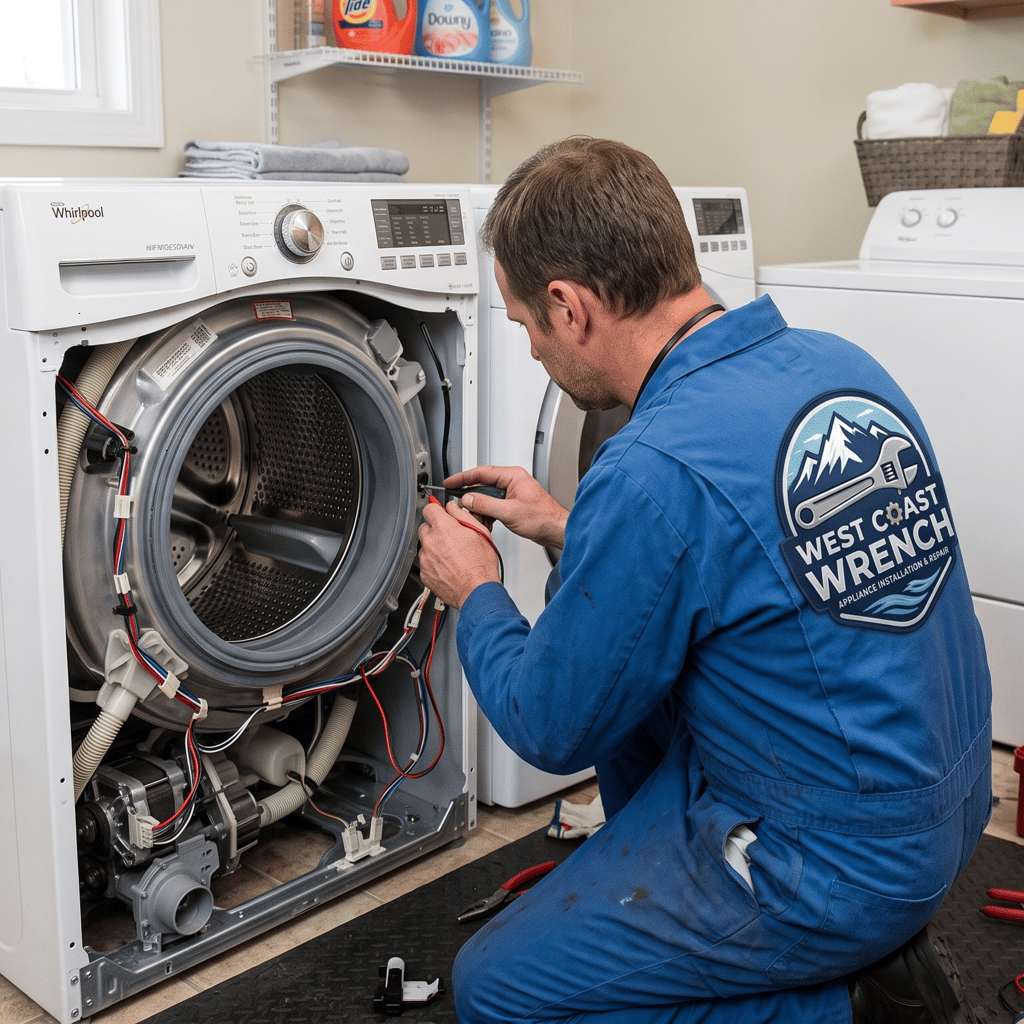
Why Washers Time Out on Water Fills
Modern washing machines do not just wait forever for a tub to fill. Their onboard microcontrollers run a strict watchdog safety timer: if the pressure transducer does not detect an expected rise in water level within 6 to 10 minutes, the machine immediately cuts power to the solenoids and flashes an error code (Samsung 4E/4C, Whirlpool LF/F8E1, LG IE).
This prevents catastrophic home flooding in case an internal bellows hose has ruptured. But when water pressure is merely weak or restricted, the safety timer shuts down the wash cycle before it even starts.
1. The #1 Cause: Clogged Sediment Mesh Screens
Every washing machine has tiny dome-shaped nylon mesh filter screens pressed inside the plastic inlet ports where the hot and cold garden-hose fittings thread on. Their job is to catch rust flakes, pipe scale, and well sediment before it can wedge open the delicate rubber valve diaphragms.
Whenever municipal water mains are flushed, or if you live on a Vancouver Island private well (in areas like Metchosin, Central Saanich, or Shawnigan Lake), sand and iron rust pack tight against those screens. A valve designed to deliver 25 litres per minute is choked down to a trickle.
How to Clean the Screens:
- Turn off the hot and cold water shutoff faucets behind the washer.
- Unthread the braided supply hoses (keep a small bucket underneath for drips).
- Look directly into the threaded plastic valve stems. You will see colored plastic mesh screens (usually blue for cold, orange/red for hot).
- Gently grip the center tab with needle-nose pliers and pull the screens out. Rinse thoroughly under tap water and scrub with an old toothbrush. Never poke holes in the mesh—reinstalling a torn screen ruins the valve.
2. Burned Solenoid Coils
Modern washers have separate 120V solenoid coils for cold wash, hot wash, bleach dispenser, and fabric softener flush. If only hot water fills but cold produces silence and a humming vibration, the cold coil winding has opened.
A healthy solenoid coil measures between 500 and 1,500 ohms on a digital multimeter. An "OL" (open loop) reading confirms the magnetic coil has burned out, requiring replacement of the entire water valve body.
3. Stuck Pilot Diaphragms
Water inlet valves do not use powerful electric motors to open; they use water pressure itself. The small solenoid simply opens a pinhole pilot bleed hole. If mineral scale or hard water salts calcify the rubber diaphragm, the pilot hole cannot bleed pressure, and the valve stays locked shut even with 120 volts applied.
Professional Washer Repair in Greater Victoria
If your sediment screens are clear and your shutoffs are wide open but your washer still halts with a fill code, our technicians carry genuine OEM water inlet valves for Samsung, LG, Whirlpool, Bosch, and Maytag for same-day repair across Greater Victoria.