
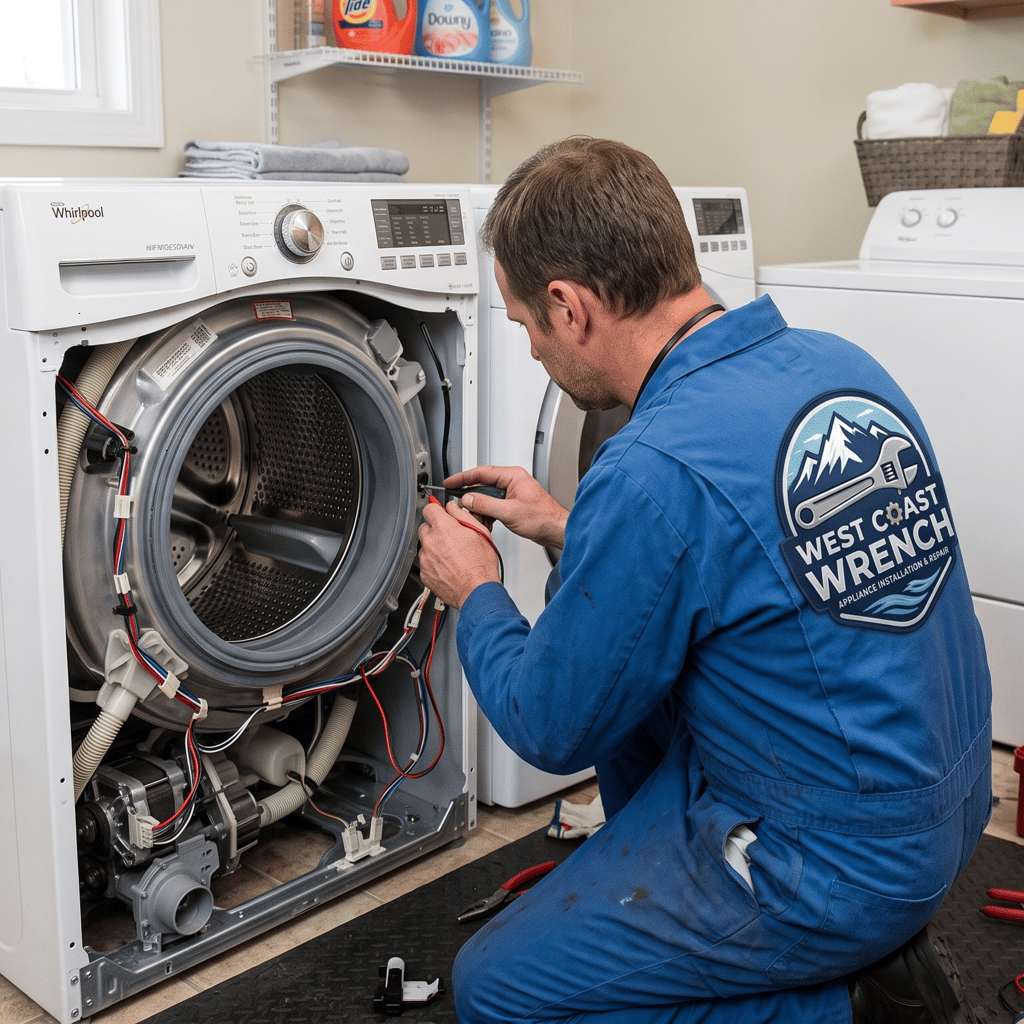
The Secret: The Machine Drained, but Aborted the Spin
Notice that there is no standing water in the tub, yet every single garment is soaked to the core. That means your drain pump succeeded, but the high-speed extraction spin (800 to 1,200 RPM) never occurred.
Modern microcontrollers monitor vibration and drum speed continuously. If an unbalanced load or an electronic sensor fault interrupts the acceleration ramp, the machine makes three redistribution attempts, gives up to protect the suspension springs, and ends the cycle prematurely.
1. The \"Single Bath Rug\" Unbalanced Load Trap
The single most common cause is not a broken part at all: washing a single heavy item (a heavy memory-foam bath mat, a winter duvet, or a single pair of heavy denim jeans).
During low-speed tumble, wet clothes must distribute evenly around the 360-degree drum perimeter. A single wet rug balls up into one corner. When the machine ramps to 400 RPM, the eccentric centrifugal weight trips the internal accelerometer (`uE` or `Ub` error). The machine fills with extra rinse water to untangle it, drains, tries again, and eventually times out. Always wash heavy items in pairs to give the drum counterbalancing weight.
2. Failing Rotor Position Sensor (Tachometer Coil)
On modern brushless Direct Drive washers, a magnetic rotor spins around stationary copper stator coils. Clipped onto the stator is a tiny 3-pronged plastic sensor called the **RPS (Rotor Position Sensor / Hall Effect Tachometer)**.
The RPS tells the inverter board the exact speed and angular position of the drum in milliseconds. If one of its miniature magnetic transistors drifts out of calibration, the inverter thinks the motor is stalling or running wildly out of control, instantly cutting power. A replacement OEM sensor clip takes 15 minutes to install and restores full 1,200 RPM spin power.
3. Failed Shift Actuator (Top-Load Washers)
On high-efficiency top-load washers (Whirlpool Cabrio, Maytag Bravos, Kenmore), the motor handles both gentle agitation and full basket spin. It shifts between modes using a small motorized cam switch called a **shift actuator**.
The actuator has a tiny synchronous motor and an optical speed wheel. If the plastic linkage snaps or the optical eye collects grease, the machine cannot engage the splutch teeth to lock the outer basket to the motor. The agitator paddles weakly, but the basket never spins, leaving clothes soaked in water.
4. Stretched or Glazed Multi-Rib Drive Belt
On belt-driven front-loaders, a multi-rib rubber serpentine belt connects the motor pulley to the large cast-aluminum drum pulley. Over thousands of heavy spin cycles, rubber stretches and loses traction. Under empty loads it spins fine, but with 20 pounds of wet laundry, the motor pulley slips, spinning harmlessly while the drum sits still.
Professional Spin Restoration in Greater Victoria
Don't burn out your dryer trying to bake soaking wet clothes! West Coast Wrench diagnoses Hall-effect tachometers, shift actuators, drive belts, and motor inverter boards for LG, Samsung, Whirlpool, Maytag, and Bosch washers across Greater Victoria.