
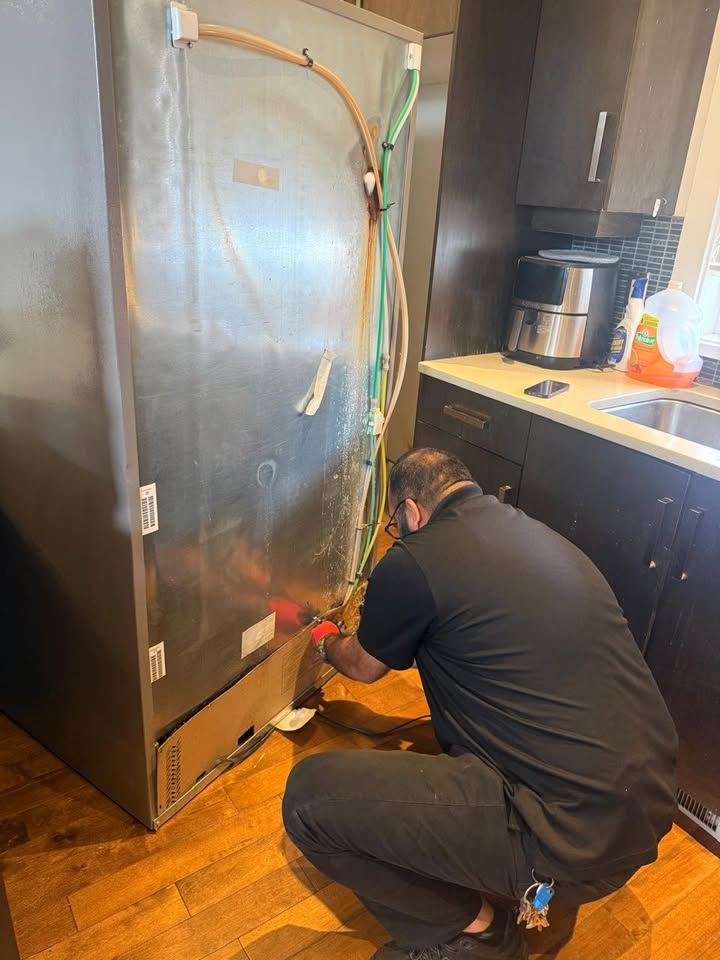
The Secret: Your Refrigerator Doesn't Make Cold Air in Both Sides
Most homeowners assume a refrigerator has two separate cooling systems: one cooling engine for the freezer and a second for the fresh food side. On 90% of residential units, that is completely false.
There is only one evaporator coil, and it lives inside the freezer compartment creating sub-zero air (-10°F to 0°F). The fresh food section stays at 37°F solely by sipping tiny metered puffs of that freezing air through a small motorized flap called an **air damper (or diffuser)**. If anything goes wrong with that air channel, your fresh food compartment becomes a second freezer.
1. The Motorized Air Damper Is Stuck Wide Open
The damper houses a miniature 12V stepper motor and a foam-insulated flap door located at the top rear of the fresh food compartment. When the compartment hits 37°F, the main board commands the flap to seal shut.
Over time, plastic gear teeth strip, or frost wedges the door in the 100% open position. Sub-zero freezer air dumps unrestricted into the top shelf, cascading down over the crisper drawers. Setting your digital control from 37°F to 42°F does nothing because the physical door cannot move.
2. The Return Air Vent Is Blocked by Groceries
Air cannot enter the fresh food section unless air can leave and return to the freezer. Along the left or bottom corner of your lowest shelf is a plastic return air louver.
If large cereal boxes, plastic containers, or grocery bags are pushed tight against this louver, natural convective circulation stops. Cold air pools permanently at the bottom around the crisper bins, freezing your produce while the top of the fridge feels lukewarm.
3. Thermistor Sensor Drift (Reading Warm When It's Freezing)
Your control board does not know the room is freezing unless its thermistor tells it. A thermistor is a temperature-sensitive resistor that changes resistance as temperature drops (typically ~10,000 ohms at 32°F).
When moisture penetrates the sensor capsule, its calibration drifts. The sensor might report a resistance that corresponds to 45°F, even though the actual air in the cabinet is 26°F. Believing the compartment is warm, the control board keeps the damper open and compressor running continuously.
Testing Before You Replace Parts
Before ordering control boards online, technicians test the thermistor in an ice bath with a precision digital multimeter and check damper motor winding resistance. Replacing a $30 sensor or $60 damper motor solves the issue permanently without buying an entire new appliance.
West Coast Wrench diagnoses French door, side-by-side, and column built-in refrigerators across Greater Victoria. We carry factory OEM dampers and thermistors for Samsung, LG, Whirlpool, KitchenAid, Bosch, and Sub-Zero.