
Why "Counterfeit Detector Pens" Do Not Work on Polymer
A widespread mistake in retail stores across Vancouver Island is cashiers rubbing traditional brown iodine counterfeit detector pens on Canadian currency. Iodine pens are completely useless on polymer banknotes.
Iodine pens react only to wood-pulp starch in cheap counterfeit paper (cotton rag money does not contain starch). Because genuine Canadian notes are non-porous synthetic plastic (polypropylene), iodine ink cannot penetrate the substrate and will smear whether the note is real or fake.
The "Feel, Look, Flip" Physical Triage Protocol
The Bank of Canada specifies a simple, rapid three-step physical check that takes less than 3 seconds at a point of sale:
- 1. Feel the Raised Ink: Run your fingertips across the large numerical denomination and the words "BANK OF CANADA / BANQUE DU CANADA". Intaglio printing creates an unmistakable raised, tactile texture that flat color photocopy fakes cannot reproduce.
- 2. Look at the Large Transparent Window: The clear vertical window must be seamlessly integrated into the polymer base, not taped or glued into a cut-out hole. Inside the window is a detailed metallic hologram portrait that perfectly matches the large portrait on the bill.
- 3. Look at the Frosted Maple Leaf: In the upper corner is a smaller transparent maple leaf with a frosted translucent outline. Holding the leaf up to a point source of light reveals hidden ring numbers matching the bill's denomination.

How Automated Commercial Counters Authenticate Notes
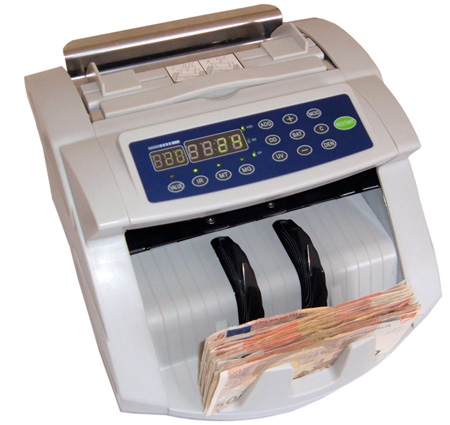
Human cashiers cannot inspect every bill during busy 500-note register drops. Commercial currency counters and discriminators authenticate notes automatically using four simultaneous physical metrics:
- Ultraviolet (UV) Transmittance: Authentic Bank of Canada polymer does not absorb or fluoresce under UV blacklight; counterfeit commercial paper or standard plastics glow brightly purple.
- Magnetic Ink (MG) Scanning: Specialized magnetic inductive pickup heads measure tiny concentrations of magnetic particles embedded in the dark black numbering inks.
- Infrared (IR) Metameric Ink: Under 850nm infrared illumination, parts of the background artwork vanish while specific security bands remain dark.
- Dimensional Thickness (Thickness Sensors): Mechanical rotary thickness micrometers measure bill thickness to 0.01 mm, detecting taped windows or double-layer fake laminates.
Commercial Cash Equipment Service in Victoria
West Coast Wrench calibrates optical UV, MG, and IR detection thresholds on commercial currency counters and discriminators for businesses, financial institutions, and cash offices across Victoria, Saanich, and Langford.